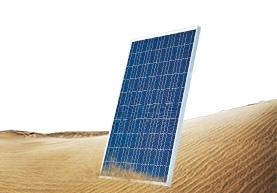
Desert Technology: Modules Made for Extremes
Standard
panels are made for regions with a moderate climate. All promises
for performance and durability are based on moderate weather
conditions; such as those found in Germany.
Many research companies (e. g. IRESEN in Morocco) have conducted
extensive tests with standard panels in desert regions or in
regions with temperature higher than those found in central
Europe: Most panels lose much of their nominal power after 10 years
and only some of panels continue to work for more than 15 years at 80%
capacity.
J. v. G. Thoma GmbH has been working on a special technology for very rough climates for more than 7 years.
Jurawatt now produces and sells these special DESERT panels all over the world. Facts about the new DESERT panels from Jurawatt can be found here.
Better Performance & More Power when it’s hot
The
hotter the cell is, the less power comes from the panel. Because we
know that every watt counts, we have developed a combination
module and cell that will generate more wattage at the same nominal
power.
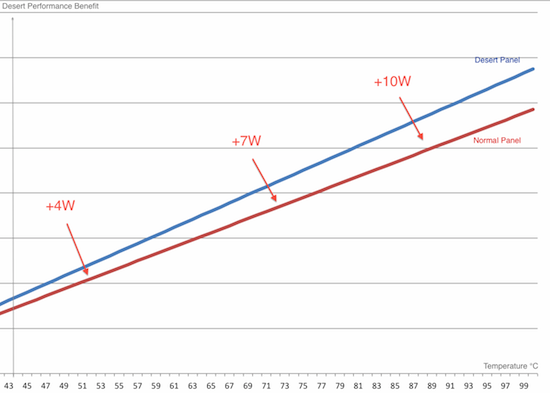
Normal PV panels have a temperature coefficient of about -0.45%/
per calorie. Our specially optimized cells improve this
coefficient by roughly 15%, which leads to improved power
generation. The power benefit will increase with each degree of
heat.
30% More Earnings & Long Life even in Hot Areas
A
damp heat test is part of simulating how a panel ages. This damp
heat test increases the temperature to 85% in combination with a
humidity of 85%. Doing this will age panels faster and simulate 20
years time when the test is performed over 1,000 hours.
If the normal temperature of the cell in hot areas will be 50-70
degree then such tests will not simulate 20 years, but rather 10-15
years maybe, because panels in hot areas will age much faster than in
Germany.
Our panel can easily survive 2,000 hours in a damp heat test without
any problems. This means that, even in desert regions, we can
guarantee lifetimes of 20 years or more.
For example, if the panel will work 30% longer than a normally
processed panel, a huge financial advantage will be created, one
that is much greater than the few cents per watt, which the technology
might cost the end consumer.
Works where other Panels fail
Not
only is the power benefit and the longer lifetime a major
advantage of Desert Technology, but also the fact that these panels
can be used in regions where other panels simply will not work.
The data sheets for most panels available on the market indicate a
maximum temperature of 85°C – 90°C. This means that if the panel
will be operating in temperatures greater than 90°C, it will be
out of spec and using it in areas where such temperatures can be
expected will not be possible, OR the performance warranty will
immediately be invalidated.
Even in Germany on hot days, cells can achieve temperatures over 80°C.
These desert panels can take temperatures up to 125°C.
JWP 260 “DESERT” – Polycrystalline Module
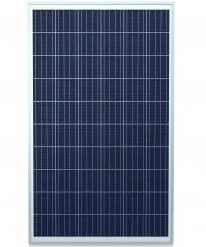
- 60 cells
- optimum power yield / area efficiency
- good price / performance ratio
- optimized for areas with high temperature
- long life in areas where other panels fail
- with HPTP technology
JWM 270 “DESERT” – Monocrystalline Module
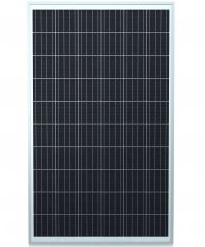
- 60 cells
- optimum power yield / area efficiency
- good price / performance ratio
- optimized for areas with high temperature
- long life in areas where other panels fail
- with HPTP technology